Fleetstock Academy
Modern Industrial Technologies Series
Topic No. 0009
Methodology for calculating losses in the production process
Prepared by: Fleetstock engineers
Published by: Fleetstock Academy
Version: 1.0
Preface
The methodology for calculating losses in the production process is an important approach to assessing the efficient use of resources — raw materials, energy, time and other means of production — at the enterprise and increasing productivity. This methodology includes the stages of identifying, measuring and analyzing actual losses occurring during production.
In modern industrial enterprises, the correct calculation of losses is of particular importance not only in terms of reducing costs, but also in terms of maintaining production stability, improving quality and clarifying management decisions.
Goals and objectives
Goal
To study the methodology for calculating losses in the production process, assess the efficiency of resource use and analyze the possibilities of applying this approach in automated control systems.
Tasks
To define the concept and types of production losses;
To explain the main stages of calculating losses;
To analyze the methods of comparing actual and normative indicators;
To study the assessment of losses in percentage terms;
To investigate the causes of technological and operational losses;
To identify optimization methods for reducing losses;
To assess the role of information technologies in this process;
To show the application of calculations in operational management decisions.
1. The concept and types of losses
In the production process, losses are understood as the difference between the planned result and the actual result. This difference may arise due to overconsumption of resources, process downtime, or a decrease in product quality indicators.
Losses are mainly divided into the following types:
Raw material losses - excess consumption, waste, and abnormal use;
Time losses - downtime, delays, and unproductive working time;
Energy loss — inefficient energy use and excess energy consumption;
Technological losses — defective products, process violations and equipment malfunctions;
Losses associated with the human factor — errors, incorrect operations and lack of control.
Correct classification of these losses allows you to identify their source and take targeted measures to eliminate them.
2. Main stages of loss calculation
The methodology for calculating losses requires a systematic approach and consists of several consecutive stages.
2.1. Data collection
At the first stage, all key indicators of the production process are collected. These include:
amount of raw materials used;
volume of products produced;
equipment operating time;
number of defective products;
energy consumption.
This data is obtained through sensors, automated systems, production reports and technical documentation. An accurate and reliable database is the main condition for correct loss calculation.
2.2. Determination of normative indicators
Normative indicators express the resource consumption envisaged by the plan. For example:
Rate of raw materials required for 1 unit of product;
Standard production time;
Energy consumption rate.
Standards are determined based on technological documentation, production standards and internal regulations of the enterprise. These indicators serve as a comparison base for assessing actual results.
2.3. Comparison of actual and normative indicators
At this stage, actual consumption is compared with normative consumption. If the actual indicator is higher than the norm, this is considered an excess loss.
Formula:
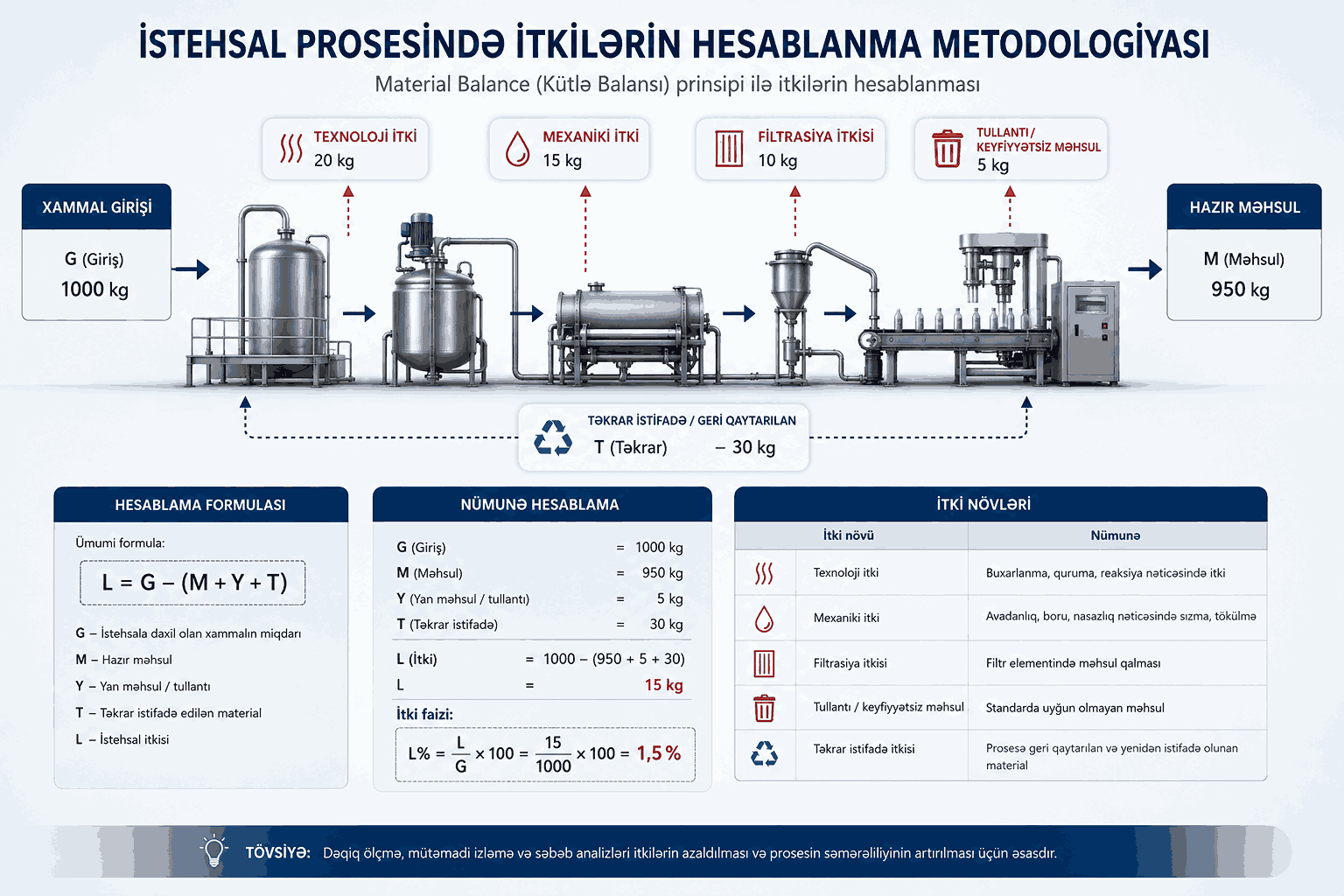
Loss = Actual consumption - Normative consumption
This approach allows you to determine in which area resources are overused.
2.4. Calculation of losses as a percentage
A percentage indicator is used to more accurately analyze production losses.
Loss percentage (%) = (Loss amount / Total resource consumed) × 100
This method allows you to compare losses at different production stages, monitor their dynamics and identify priority problems.
3. Analysis of technological and operational losses
To determine the causes of losses, the production process is analyzed by stages. The main reasons are:
equipment failure;
technological regime violation;
operator errors;
poor-quality raw materials;
planning problems.
This analysis helps to identify weak points in the enterprise, improve processes and reduce losses at the source. As a result of the analysis, problems of both technical and organizational nature are revealed.
4. Methods for optimizing losses
Loss calculation serves not only the purpose of measurement, but also creates the basis for their reduction. The main optimization methods are:
automation of production processes;
implementation of real-time monitoring systems;
organization of preventive maintenance;
strengthening of quality control;
training and advanced training of personnel.
These measures ensure more efficient use of resources, reduce the number of defects and increase the overall efficiency of production.
5. The role of information technologies
In modern production, losses are automatically calculated and analyzed through ERP, SCADA and other information systems. These systems perform the following functions:
collect data in real time;
conduct statistical analysis;
accelerate decision-making;
identify risky points, that is, critical control points.
The application of digital solutions minimizes errors caused by the human factor and allows for more flexible control of the production process.
6. Application of calculations in management decisions
Loss calculation is one of the main sources of information in making operational management decisions. Accurate calculations allow management to assess the state of resources and take timely measures.
Based on the calculations:
the production plan is adjusted;
the resource allocation is optimized;
technological regimes are reorganized;
the level of preparedness for emergencies is increased.
This approach ensures flexible management of the enterprise and serves to reduce risks in production processes.
Scientific and practical result
The methodology for calculating losses in the production process is one of the main technical and economic mechanisms that ensure the efficient use of resources. The complex application of accurate calculation, comparison, analysis and optimization methods creates conditions for reducing costs, increasing productivity and maintaining the stability of production processes at the enterprise.
Conclusion
The methodology for calculating losses in the production process is of great importance in terms of increasing the efficiency of the enterprise, reducing costs and improving product quality. Through a properly established methodology, losses are accurately measured, the causes are analyzed and optimization measures are implemented, ensuring the sustainable development of the production process.
This approach not only helps to identify current losses, but also to prevent them in the future. As a result, the enterprise has a more sustainable, more flexible and more competitive production environment.
Contact
📞 Mobile: (+994 77) 311 56 66
☎️ Phone: (+994 12) 347 93 06
📧 Email: info@fleetstock.az
🌐 Web: www.fleetstock.az